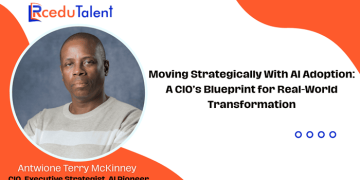




At Rcedutalent, we take pride in showcasing visionary leaders who are driving innovation and shaping the future through strategic thinking and global impact. Today, we are honored to feature Antwione Terry McKinney, a distinguished CIO, executive strategist, and AI pioneer, whose powerful insights on strategic AI adoption and real-world transformation are guiding organizations toward responsible, ethical, and human-centered digital excellence.
A Global Foundation for Strategic AI Leadership
For more than 25 years, I’ve lived at the intersection of technology, leadership, and organizational transformation. My journey has taken me from banking and healthcare to higher education and enterprise modernization, each chapter reinforcing a simple truth: AI is not a technology project. It is an organizational strategy.
Like many leaders shaping the next era of digital capability, I’ve seen firsthand how culture, governance, and operational readiness determine whether AI becomes a competitive advantage or an expensive experiment. My work as a CIO and AI strategist has been rooted in helping organizations move with intention, not hype, and build systems that scale, sustain, and serve.
From IT Modernization to AI Maturity
Across my roles, from directing IT operations in hospitals and universities to leading digital transformation initiatives, one pattern has remained constant: AI succeeds only when the foundation is strong.
Organizations often rush toward AI tools without addressing the essentials:
- Fragmented data
- Outdated infrastructure
- Undefined governance
- Misaligned expectations
- Cultural resistance
This is where strategic leadership becomes non‑negotiable. AI adoption requires the same discipline as any enterprise‑level transformation: clarity, alignment, and operational truth. Without these, even the most advanced models will fail to deliver meaningful impact.
The Three Pillars of Strategic AI Adoption
When considering well-defined strategic focus areas, my approach centers on three pillars that determine whether AI becomes transformative or disruptive in the wrong ways.
-
Governance Before Gadgets
AI governance is not bureaucracy, it is protection. It ensures:
- Ethical use
- Data integrity
- Security and compliance
- Clear ownership
- Transparent decision‑making
Organizations that skip governance end up with shadow AI, inconsistent outputs, and operational risk. Governance is the guardrail that keeps innovation safe and sustainable.
-
Infrastructure That Can Carry the Weight
AI exposes weaknesses. If your network, storage, cybersecurity posture, or data architecture is fragile, AI will magnify every crack.
Strategic AI adoption requires:
- Modernized infrastructure
- Cloud‑ready or hybrid environments
- Strong identity and access controls
- Scalable data pipelines
AI is only as strong as the system supporting it.
-
Culture That Can Absorb Change
AI transformation is 20% technology and 80% people. Teams must be:
- Trained
- Empowered
- Involved
- Supported
Without cultural readiness, AI becomes a threat instead of a tool. With it, AI becomes a multiplier of human capability.
Turning Strategy Into Real‑World Impact
Throughout my career, I’ve led organizations through modernization efforts that required not just technical upgrades but operational courage. Whether implementing enterprise systems, building AI‑ready data environments, or aligning cross‑functional teams, the goal has always been the same: create systems that elevate people, not replace them.
AI adoption done well:
- Reduces operational friction
- Strengthens decision‑making
- Enhances student, patient, or customer experiences
- Improves continuity and resilience
- Frees teams to focus on higher‑value work
This is the difference between implementing AI and integrating AI.
A Vision for the Future: Strategic, Ethical, Human‑Centered AI
As organizations worldwide accelerate their AI ambitions, the leaders who will thrive are those who move with intention, not urgency. The future belongs to institutions that build AI strategies grounded in governance, infrastructure, and culture.
As we chart towards the future, my mission is to help organizations adopt AI in ways that are responsible, resilient, and deeply human.
AI is not here to replace leadership. AI is here to demand better leadership.
And the organizations that embrace that truth will define the next era of digital excellence.
Read Also: Ashish Bhati: The Visionary Behind Allegiance Educare