


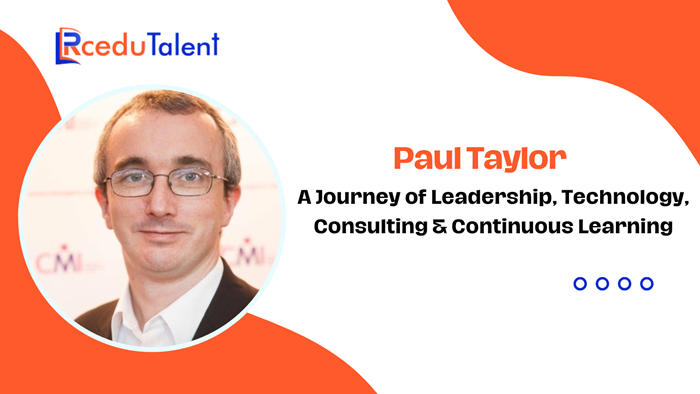
In today’s exclusive feature, we spotlight Paul Taylor, an experienced technology and change leader, consultant, advisor, author, and mentor. With a career spanning technology, business transformation, leadership, and education, Paul brings a practical, people-focused approach to navigating complex challenges.
In this conversation, Paul shares his insights on business transformation, AI, emerging technologies, leadership, mentoring, and continuous learning, while reflecting on his journey and the lasting impact he hopes to create through his work.
Table of Contents
ToggleWhat inspired your remarkable journey across technology, finance, consulting, and education?
There are three main reasons why I am interested in this type of work. The first is that I genuinely enjoy the work itself. Every project presents a different set of challenges, and I find it rewarding to take the time to understand the underlying issues, analyse the situation, and develop practical solutions. I enjoy work that requires both critical thinking and creativity, and I find it motivating to help solve complex problems that can make a real difference.
The second reason is the opportunity to work with a wide range of interesting people and organisations. I enjoy collaborating with individuals from different backgrounds, learning about their perspectives, and working together towards shared goals. Building strong relationships and understanding how different organisations operate are aspects of the role that I find particularly engaging.
Finally, I really value the variety that this type of career offers. No two projects are the same, which means there is always something new to learn. Whether it is working in a different industry, tackling a new business challenge, or developing new skills, the constant variety keeps the work interesting and allows me to continue learning and growing throughout my career.
What motivated you to move from corporate leadership to independent consulting?
After many years in change and technology leadership, I wanted to use my experience differently and build a more varied portfolio career.
Rather than focusing on a single organisation, I wanted the opportunity to work across different industries, sectors and challenges, combining consulting, advisory, board and educational roles.
A portfolio career gives me the flexibility to apply my experience where I can add the most value, while continuing to learn, develop new perspectives and work with a broader range of people and organisations. For me, it was less about stepping away from corporate leadership and more about using the experience I had gained more independently and diversely.
What is the biggest key to making a business transformation successful?
Managing the human nature of change is the biggest thing to making change successful. Remember that change is triggered by people, implemented by people, and then used by people.
This means that successful transformation depends on bringing people with you, understanding their concerns, communicating clearly, and creating a sense of ownership.
What does great leadership mean to you in today’s fast-changing world?
I know that society, technology, etc have changed over time, but the core elements of leadership have been the same for years (although in today’s fast-changing world, leaders need to be adaptable)
Therefore, great leadership today is about providing clarity, creating trust and enabling people to perform at their best, particularly when the environment is changing quickly.
The best leaders do not pretend to have all the answers. They set a clear direction, explain the why, listen to different perspectives and then give people the confidence and autonomy to deliver.
I also think there is a strong human element to leadership. Technology, AI and new operating models can transform how organisations work, but successful change ultimately depends on people. Great leaders understand the impact of change on individuals, communicate openly and bring people with them rather than simply imposing change.
Ultimately, I would describe great leadership as creating the conditions in which people can succeed, namely providing direction and accountability while giving them the trust, support and freedom to make a difference.
How can businesses use technology to create lasting growth and impact?
Businesses should see technology as an enabler of growth, not simply a way to reduce costs. The real value comes from using AI, data and automation to improve decision-making, customer experience and productivity. This means that technology alone is not enough. Lasting impact comes from combining it with strong leadership, good processes and bringing people with you through change.
Which emerging technologies do you believe will reshape businesses the most?
I think AI (and especially Machine Learning) will have the biggest impact, especially as they become embedded into everyday business processes, decision-making and customer experiences. However, the real value of ML depends on the quality, availability and governance of data. Businesses that can turn high-quality data into actionable insight will have a significant competitive advantage.
Alongside AI and ML, I see automation, advanced analytics and tokenisation reshaping how organisations operate. Ultimately, it will be the combination of technology, high-quality data and human expertise that creates the greatest impact.
What have you learned from mentoring and developing the next generation of leaders?
Mentoring has been incredibly fulfilling, particularly seeing people develop their confidence and capabilities over time. But it is also a two-way process. I have learned a great deal from my mentees, particularly from their different perspectives, experiences and approaches to new challenges. It has reinforced for me that great mentoring is about listening as much as advising. You can share experience, but you also need to remain open to learning yourself.
What inspired you to become an author, and what message do you want readers to take away?
Becoming an author was partly about ‘forcing myself to learn’. Writing means you have to research a subject, challenge your own thinking and really understand it before you can explain it to others.
There is also something very satisfying about seeing your name in print and knowing that your ideas might be useful to someone else.
Ultimately, I hope readers take away a new idea, a different perspective or simply the motivation to think differently. Writing is another way of sharing knowledge and learning from others.
How do you stay ahead in an era of constant technological change?
For me, staying ahead is about never stopping learning. I learn through a combination of reading, taking courses, and listening to others. And perhaps most importantly, ‘learning by doing’. Actually applying new technology and experimenting with it teaches you things that theory alone cannot. I also learn a great deal by ‘watching how other people approach new technologies’. You do not have to be an expert in everything; being curious, asking questions, and being prepared to learn from others is often more valuable.
What legacy do you hope to leave through your work, leadership, and mentorship?
I would like my legacy to be fairly simple: that I did a good job, knew what I was talking about and, importantly, looked after the people I worked with. I would like people to remember me as someone knowledgeable and professional, but also approachable, supportive and simply a nice person to work with.
If I can leave people feeling that I made a positive difference to their careers, their organisations, society and their lives, then I would consider that a worthwhile legacy.
Read Also: The Future of Web3 Culture: Inside GMA’s Artenis (ATNS) Ecosystem Vision