


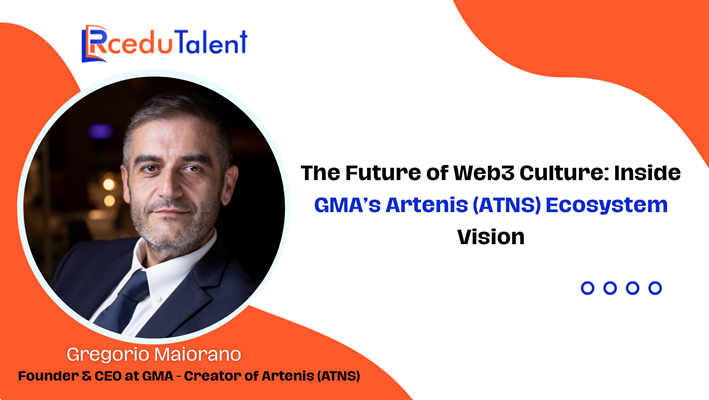
Name: Gregorio Maiorano
Company and Job Title: Founder & CEO at GMA – Creator of Artenis (ATNS)
Table of Contents
ToggleGMA’s Artenis (ATNS): Can Web3 Finally Build a Scalable Cultural Infrastructure?
For years, blockchain projects promised to revolutionize entire industries. Most failed.
The reasons are familiar: speculation without utility, token models without sustainable demand, communities built around price rather than participation, and ecosystems that never evolved beyond white papers and hype cycles.
Now, as the digital asset market matures, a new category of projects is beginning to emerge—less focused on speculative narratives and more oriented toward infrastructure, real-world utility, and sector-specific applications. One of the more interesting entrants in this space is Artenis (ATNS), the utility token recently introduced by GMA, a company positioning itself at the intersection of art, culture, immersive technology, and blockchain infrastructure. But unlike traditional token launches, this appears to be less about launching a coin—and more about building a programmable cultural ecosystem.
Beyond the Token Launch Narrative
At first glance, Artenis might appear to be yet another ERC-20 token entering an already saturated digital asset landscape. But a closer look suggests a different ambition.
According to GMA’s strategic framework, ATNS is designed not as a speculative investment vehicle but as the operational utility layer within a broader ecosystem intended to connect cultural experiences, digital access, blockchain transparency, and future marketplace services. That distinction matters. Because in 2026, the question is no longer whether blockchain can create tokens. The question is whether blockchain can create ecosystems that people actually use.
GMA’s thesis appears to be that culture—particularly the global art sector—may offer one of the strongest environments for meaningful blockchain integration.
Why the Art World Is Still Ripe for Disruption
Despite its prestige and scale, the global art ecosystem remains structurally fragmented.
Access is frequently constrained by:
- Institutional gatekeeping
- Geography
- Opaque provenance systems
- Exclusivity barriers
- Limited digital interoperability
Outdated participation models
Meanwhile, digital-native audiences increasingly expect interaction, transparency, access and ownership frameworks that traditional cultural structures often struggle to provide. This creates an unusual opportunity. Because blockchain, when properly applied, solves several real problems that matter in cultural ecosystems:
- Verifiable provenance
- Transparent transaction records
- Programmable access rights
- Digital certification layers
- NFT-native ownership infrastructure
- Community participation models
- Tokenized engagement ecosystems
The challenge has always been execution. That’s where GMA is trying to differentiate. Building a Cultural Operating System. Rather than positioning itself as an art marketplace alone, GMA appears to be attempting something larger: building what could be described as a digital operating system for cultural participation. Its planned ecosystem includes multiple interconnected layers.
Virtual Museum
One of the flagship pillars is a Virtual Museum, envisioned as an immersive digital environment where users can interact with collections, cultural content and artistic experiences beyond physical constraints. This is not a new idea in concept. But most prior implementations lacked ecosystem cohesion. GMA’s differentiator may lie in connecting immersive access with blockchain-native infrastructure.
Marketplace Infrastructure
The roadmap also points toward marketplace functionalities that may support:
- Premium digital services
- Nft integrations
- Collectibles
- Provenance systems
- Ecosystem-native transactions
- Strategic partner integrations
- Digital ownership experiences
This suggests an ambition closer to platform infrastructure than isolated product development.
Community Layer
The project also emphasizes community participation, memberships, loyalty mechanisms, and digital engagement systems. This is strategically important. The strongest Web3 ecosystems are rarely built on transactions alone. They are built on participation loops. If GMA executes this correctly, ATNS becomes less a token—and more a permission and interaction layer across a broader ecosystem.
So What Exactly Is Artenis?
Technically, Artenis is straightforward:
- Ticker: ATNS
- Blockchain: Ethereum
- Standard: ERC-20
- Supply: 50 million fixed
- Mint Status: Fully minted
Its intended role is utility, not ownership.
Potential ecosystem functions include:
- Premium access
- Event participation
- Membership activation
- Marketplace interactions
- Nft-linked utility
- Digital certification mechanisms
- Ecosystem engagement
The project explicitly distances itself from equity, securities, profit participation or financial return promises. That positioning is increasingly essential in today’s regulatory environment.
The Bigger Strategic Question
The most interesting question is not whether Artenis works technically. That’s relatively easy.
The harder question is whether GMA can create sustainable internal demand. Every utility token faces the same existential challenge:
Why should anyone continue using this token once the novelty fades?
That answer depends on ecosystem depth.
A utility token only survives if:
- The ecosystem delivers real utility
- Access is meaningfully gated through token logic
- User behavior becomes habit-based
- Partnerships create external relevance
- Token utility expands over time
Without these dynamics, utility tokens become decorative. With them, they become infrastructure.
A Post-Speculative Web3 Play?
Timing may work in GMA’s favor. The Web3 narrative has evolved. Institutional players are increasingly less interested in meme-driven volatility and more focused on infrastructure, tokenized access, digital identity, real-world asset integration, and programmable ecosystems.
Culture may be one of the few sectors where blockchain’s capabilities align naturally with real operational needs.
- Authenticity
- Ownership
- Participation
- Certification
- Digital access
- Cross-border interaction
If GMA succeeds, Artenis could represent an early example of a broader trend: sector-native Web3 infrastructure rather than finance-native token speculation.
The Risks
Of course, the risks are significant. Execution remains everything.
GMA must still prove:
- Product delivery
- Ecosystem usability
- Meaningful partnerships
- Community growth
- Regulatory resilience
- Long-term adoption
Building cultural infrastructure is exponentially harder than launching a token contract. Many projects underestimate that gap.
Final Take
The blockchain sector does not need more tokens. It needs credible ecosystems. Artenis is interesting not because it introduces another digital asset. It is interesting because it attempts to answer a far larger question.
Can Web3 infrastructure meaningfully transform how culture is accessed, experienced and monetized globally?
That remains to be seen. But if GMA delivers on even part of its stated vision, Artenis may become less of a token story and more of an infrastructure story. And those are the projects worth watching.
Read Also: Inês Abdalla: From Personal Pain to Building Three Purpose-Driven Brands